- Details
-
By Texas A&M University
Natural Gas Storage Research Could Help Combat Global Warming
Since 1906, the global average surface temperature has increased by more than 1.6 degrees Fahrenheit — even more in certain polar regions. While this doesn’t seem a lot, the effects of this global warming are becoming more and more apparent. The heat is melting glaciers, shifting precipitation patterns and forcing animals to move from their natural habitats.
To help combat global warming, a team led by Dr. Mert Atilhan from Texas A&M University and Dr. Cafer Yavuz at the Korea Advanced Institute of Science and Technology (KAIST), is working on a new porous polymer that can store natural gas more effectively than anything currently being used. Their research focuses on adsorbed natural gas (ANG), a process to store natural gas that is a safer and cheaper alternative to compressed natural gas and liquefied natural gas.
“Currently we are facing serious issues that are related to global warming due to the excessive use of coal and petroleum,” Atilhan said. “Natural gas is a much cleaner source and there is an abundant amount of gas being explored in the United States, the Mediterranean Sea and elsewhere all around the world. If natural gas can be stored effectively, it can be utilized easily, even in remote areas.”
Read more at: Texas A&M University
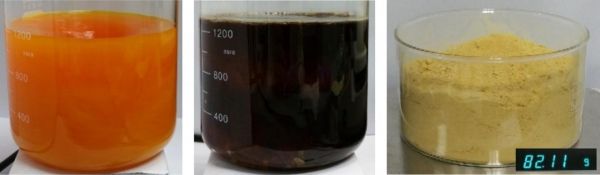
Synthesis at small scale (82.11 grams of product). Note that the reaction is carried out in a beaker open to air. (Photo Credit: Vepa Rozyyev/Texas A&M University)