- Details
-
By University of Southampton
Repeating Outflows of Hot Wind Found Close to Black Hole
An international team of astrophysicists from Southampton, Oxford and South Africa have detected a very hot, dense outflowing wind close to a black hole at least 25,000 light-years from Earth.
Lead researcher Professor Phil Charles from the University of Southampton explained that the gas (ionised helium and hydrogen) was emitted in bursts which repeated every 8 minutes, the first time this behaviour has been seen around a black hole. The findings have been published in the journal Monthly Notices of the Royal Astronomical Society.
The object Professor Charles's team studied was Swift J1357.2-0933 which was first discovered as an X-ray transient – a system that exhibits violent outbursts - in 2011. These transients all consist of a low-mass star, similar to our Sun and a compact object, which can be a white dwarf, neutron star or black hole. In this case, Swift J1357.2-0933 has a black hole compact object which is at least 6 times the mass of our Sun.
Read more at: University of Southampton
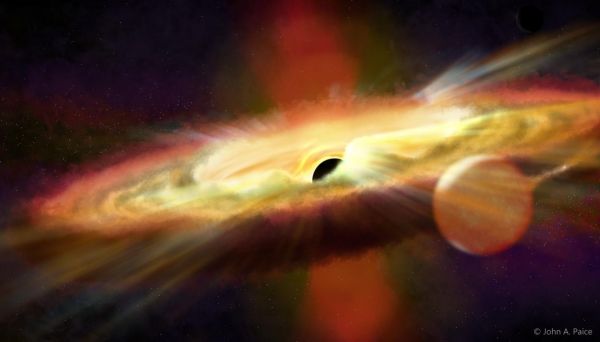
Schematic illustration of J1357.2-0933 (Photo Credit: John Paice)